admin01@oshujian.com
What are the best practices for retractable belt barrier layouts at key locations such as transit areas, customs, and boarding gates?
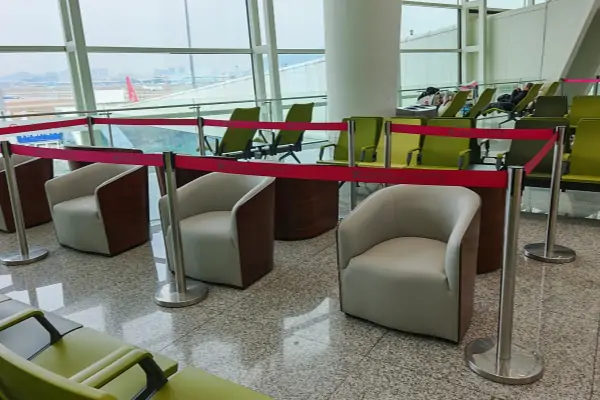
In airport terminals, transit areas, customs, security checkpoints, and boarding gates are the most congested and prone to congestion. A scientifically designed retractable belt barrier system can not only effectively manage passenger flow and maintain queue order, but also significantly improve throughput and passenger experience. What are the best practices for queuing barrier layouts in these high-traffic areas?
I. Spacing and Density: Dynamic Control Adapted to Local Conditions
The spacing between the retractable belt barriers directly determines queue capacity and control effectiveness. In a standard layout, the spacing between the barriers is typically 1.5 to 2.5 meters (approximately 6 to 9 feet), suitable for common retractable belt lengths of 2 to 3 meters. In high-density areas such as security checkpoints and customs lanes, it is recommended to tighten the spacing to 1.2 to 1.5 meters (approximately 5 to 6 feet) to prevent passengers from cutting in line or crawling under them. In relatively open areas such as boarding gates, spacing can be appropriately widened, and retractable barriers can be used to flexibly adjust the width of the passageway. Double-layer retractable barriers, by adding webbing in the lower middle section, create a more complete physical barrier, effectively reducing queue-jumping and crawling, and are especially suitable for high-frequency queuing areas such as security checkpoints and customs.
II. Serpentine Queues: Maximizing the Use of Limited Space
In areas with limited space, such as transit areas and customs, the biggest advantage of queuing barriers is the ability to quickly establish serpentine queues. A single barrier post can connect to multiple adjacent posts, using a repeatedly turning passageway design to accommodate more queuing passengers within limited floor space. Wall-mounted retractable barriers anchor the queue to the wall, extending the queue length without additional posts, making them particularly suitable for narrow spaces such as boarding gate corridors.
III. Differentiated Layout Strategies for Key Nodes
Security and Customs: Utilizing double-layer queuing barriers, along with clear one-meter lines and entrance signage, prevents passengers from turning back and missing checks.
Boarding Gate: To address the issue of easily congested aisles, L-shaped retractable barriers are used, utilizing the available space next to seats, along with clearly marked entrance signs.
Transit Area: Dedicated retractable barrier lanes are set up to separate international and domestic transit passengers, preventing cross-traffic.
IV. Selection and Installation Considerations
When purchasing airport retractable barriers, consider the following: ① Post material – stainless steel or powder-coated steel, corrosion-resistant and easy to clean; ② Retractable barrier length – 2 to 3 meters is a common standard, with 4-meter long-pitch models available for special areas; ③ Base stability – in high-traffic areas, prioritize weighted bases or ground-mounted models; ④ Slow retraction system – to prevent safety hazards caused by rapid webbing retraction.
Summary
Best practices for retractable barriers at key points such as transit areas, customs, and boarding gates can be summarized as: dynamic spacing adjustment, serpentine queuing to maximize space utilization, and differentiated layout at key points. A well-designed airport queuing barrier system is a fundamental configuration for ensuring orderly passenger flow and improving airport operational efficiency.
Leave a message
Welcome you to leave your contact information and message, we will contact you by a personal person