admin01@oshujian.com
Do Different Areas of an Airport Require Different Types of Waste Bins?
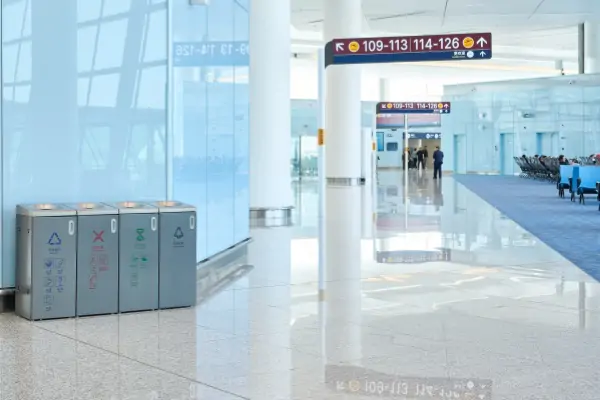
The answer is: absolutely. Airport waste bins must do more than simply "hold trash"; they must also meet the multifaceted challenges posed by passenger density, safety standards, cleaning frequency, and aesthetic appeal. A smart waste management strategy for a terminal will select specific materials—such as stainless steel, flame-retardant composites, or soft-padded finishes—based on the unique characteristics of each zone, thereby enhancing operational efficiency and reducing long-term costs.
I. Departure Hall & Check-in Area: Stainless Steel Preferred
This is the area where passengers spend the most time and where luggage is frequently dragged across the floor. Stainless steel airport bins are characterized by their impact resistance, scratch resistance, and ease of cleaning. Their surfaces often feature a brushed finish or anti-fingerprint coating, and—combined with a design free of sharp edges—they help prevent scratches to suitcases and injuries to children. Furthermore, stainless steel does not absorb odors and will not rust even after daily high-pressure washing, making it ideal for high-traffic public areas with rigorous hygiene requirements.
II. Security Check Queuing Area: Soft-Padded or Flame-Retardant Materials
In the security area, passengers frequently bend down to open bags and discard items like water bottles and lighters; moreover, high passenger density makes accidental bumping and jostling common. For this zone, soft-padded airport bins (featuring an outer layer of PU or silicone) are recommended to prevent injuries caused by accidental collisions. Simultaneously, these units incorporate flame-retardant inner liners capable of extinguishing cigarette butts and preventing the spread of fire. This dual design—offering both collision protection and fire resistance—is becoming increasingly prevalent in major hub airports both domestically and internationally.
III. Concourses & Boarding Gates: Flush-Mounted + Galvanized Steel
Space is at a premium in waiting areas; therefore, flush-mounted waste bins—recessed directly into the walls—offer the most efficient use of aisle space. The preferred material is galvanized steel treated with an outdoor-grade powder coating, ensuring corrosion resistance while allowing the bin's color to harmonize with the terminal's interior decor. Some high-end solutions incorporate sound-dampening and vibration-absorbing rubber rings around the disposal opening to minimize the metallic clatter of discarded items, thereby enhancing the overall tranquility of the waiting environment.
IV. Arrivals Hall & Baggage Claim: Large-Capacity Rotomolded Bins
After retrieving their luggage, passengers often discard a significant amount of packaging materials, resulting in a high volume of waste generated at specific points. For these areas, rotomolded high-density polyethylene (HDPE) bins are highly recommended. These bins are seamlessly molded as a single unit—eliminating weak points like weld seams—and are highly resistant to drops, chemical corrosion (acids and alkalis), and are lightweight for easy handling. Equipped with heavy-duty casters and drainage holes at the base, the units allow cleaning staff to quickly wheel them to a waste collection room for washing and disinfection.
V. Smoking Rooms and Outdoor Walkways: Weather-Resistant, Flame-Retardant Materials
Outdoor or semi-open areas must be capable of withstanding exposure to wind, rain, and high-temperature cigarette butts. It is essential to select materials such as 304 stainless steel or flame-retardant composites, and to ensure units are fitted with a cigarette-extinguishing top plate and a fireproof inner liner. Note: Ordinary plastic bins are prone to aging and becoming brittle under extreme weather conditions; therefore, materials used for outdoor airport litter bins must meet standards for UV resistance (anti-aging) and flame retardancy (UL94 V-0).
Summary and Procurement Recommendations
Matching specific airport litter bin materials to their respective zones is not an added expense; rather, it represents a strategy to achieve maximum safety and cleanliness benefits with minimal maintenance investment. Prior to placing a bulk order, it is recommended that you request the supplier to provide a zone-specific configuration plan, material test reports, and a full-scale (1:1) sample for on-site evaluation. A scientifically zoned airport waste management system can make your terminal safer, quieter, and more cost-efficient.
Leave a message
Welcome you to leave your contact information and message, we will contact you by a personal person