admin01@oshujian.com
Should airport lounge chair selection prioritize capacity and layout or ergonomics?
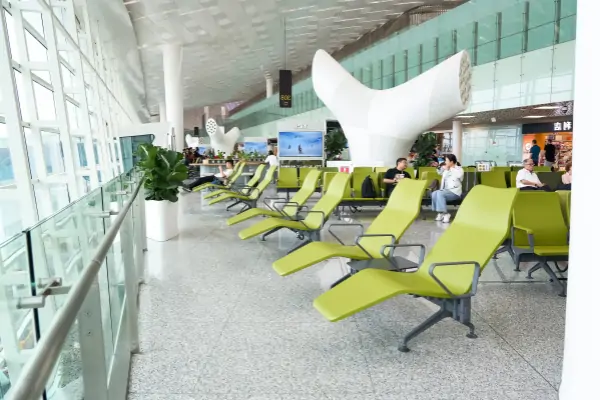
The answer is: capacity and layout are not mutually exclusive, but high-traffic airport lounges should prioritize ensuring basic capacity, and then incorporate ergonomics through modular design. Blindly pursuing "large and sparse" or "small and luxurious" layouts can easily backfire. Truly high-return airport lounge chair selection achieves a dynamic balance between "having enough space" and "sitting comfortably" within a limited area.
1. First, calculate "throughput": Capacity is the prerequisite for experience. What's the worst experience in a VIP lounge? It's having coffee but not being able to find a seat. The primary task of airport lounge chairs is to handle peak passenger flow. For example, at an airport with an annual throughput of 50 million passengers, 0.8-1.2 people per square meter are needed during peak hours. Prioritizing armrest-free or shared armrest lounge seating units can increase seating density by more than 25%. Compact airport lounge seating, combined with flexible movable sofa modules, can be quickly switched between single, double, or four-person business groups. This capacity-first layout strategy directly determines the service capacity and waiting satisfaction of the VIP lounge.
2. Further Focus on "Endurance": Ergonomics Determines Stay Intention. Short-haul transit passengers are less sensitive to seat firmness, but long-haul passengers with 2-4 hour layovers are most concerned about unsupported lower backs and insufficient neck support. Ergonomic airport lounge chairs need to have adjustable headrests, lumbar support, and a 120°-135° reclining angle. In recent years, high-end VIP lounges have favored semi-reclining lounge recliners with integrated footrests, significantly reducing passenger fatigue. Data shows that VIP lounges equipped with ergonomic reclining chairs extend the average passenger stay by 18% and increase food and beverage spending by 12%.
3. Optimal Solution: Zoning + Mixed Styles. No need for uniformity across the entire lounge. The entrance and exit traffic areas utilize high-density seating to address waiting and short-stop needs; quiet areas by the windows feature individual ergonomic reclining chairs, with partitions creating a sense of privacy. The modular airport lounge system allows for quick replacement of cushions, armrests, and charging modules along the same track, satisfying both capacity flexibility and zoned comfort.
When procuring airport lounge furniture, it is recommended to request suppliers to provide dual-mode configuration options: switchable between peak-hour expansion and off-peak comfort. True selection wisdom is not about choosing one or the other, but about using 20% of the area for a comfort premium and 80% for flexible capacity.
Leave a message
Welcome you to leave your contact information and message, we will contact you by a personal person