admin01@oshujian.com
How Long Do Airport Retractable Belt Barriers Last? What Factors Determine Their Lifespan?
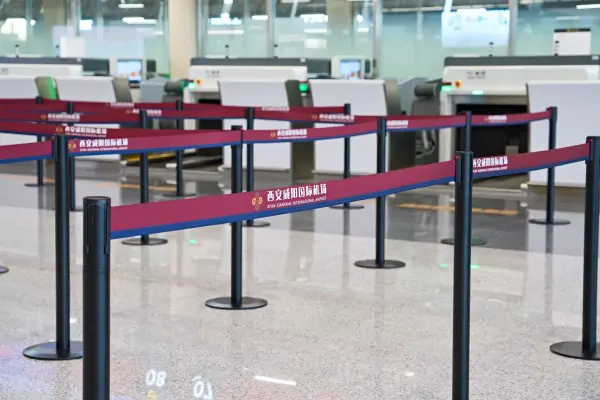
Airport Retractable Belt Barriers serve as essential equipment within terminal buildings for guiding queues and cordoning off specific areas. A high-quality airport queuing barrier typically has a service life of 5 to 8 years, while high-end commercial models can last for over 10 years with proper maintenance. However, the actual lifespan is determined by the following four key factors:
1. Materials: The Grade of the Housing and Webbing
The housing of a retractable belt barrier is typically constructed from ABS engineering plastic, stainless steel, or powder-coated steel. ABS is lightweight but offers only moderate impact resistance; stainless steel and steel housings are more resistant to collisions, making them suitable for areas with frequent luggage cart traffic. Regarding the barrier webbing, polyester webbing offers superior UV resistance and fade resistance compared to standard nylon, while abrasion-resistant webbing helps minimize fraying after prolonged stretching. Some airport barriers also feature antimicrobial webbing, making them ideal for high-contact areas such as security checkpoints.
2. Core Mechanics: The Retraction and Locking System
The automatic retraction mechanism is the heart of a retractable belt barrier. Models utilizing a constant-force spring system offer smooth retraction and a low failure rate; conversely, inexpensive spiral springs are prone to weakening within 2 to 3 years, resulting in feeble webbing retraction. The material used for the locking mechanism is equally critical—metal ratchets are significantly more durable than plastic latches, capable of withstanding tens of thousands of extension and locking cycles.
3. Operating Environment: Indoor vs. Semi-Outdoor
Climate-controlled environments within the airport—such as departure halls and arrival areas—are the most favorable settings for queuing barriers, allowing them to reach the upper limits of their expected lifespan. In semi-outdoor areas (e.g., connecting walkways or shuttle bus waiting zones), however, barrier webbing exposed to prolonged direct sunlight, temperature fluctuations, and humidity can age at twice the normal rate. Opting for UV-resistant webbing and stainless steel bases can significantly extend the barrier's service life in such environments.
4. Maintenance Frequency and Methods
The routine maintenance of retractable belt stanchions directly impacts their service life. It is recommended to clean the webbing and housing quarterly, check the spring's retraction force every six months, and lubricate the base's swivel mechanism. Keeping spare webbing on hand allows for quick replacement in the event of wear and tear, thereby preventing the need to discard the entire unit. Customers who implement a maintenance plan for their airport retractable belt barriers see an average 30% extension in the service life of their equipment.
Summary
If you are currently sourcing retractable belt barriers for an airport, prioritize models featuring stainless steel bases, polyester webbing, and constant-force spring systems, and establish a routine inspection protocol. A reliable set of airport queuing stanchions not only eliminates the costs associated with frequent replacements but also consistently ensures the maintenance of passenger order and safety.
Leave a message
Welcome you to leave your contact information and message, we will contact you by a personal person