admin01@oshujian.com
Given the high volume of foot traffic at airports, how can charging bar tables and chairs be designed to remain stable, durable, and free from loosening?
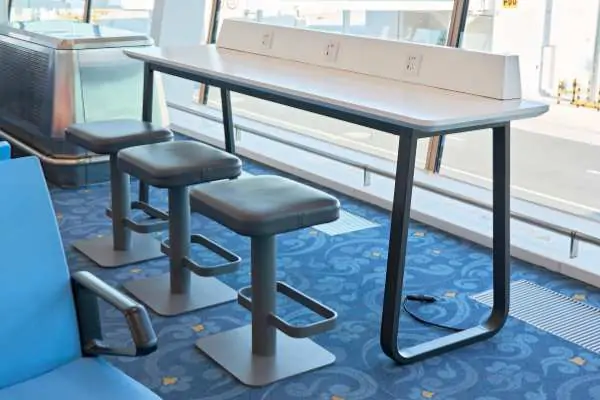
In airport waiting areas, charging bar tables and chairs are frequently sat upon, leaned against, and shifted by hundreds of people every day. Consequently, within less than six months, issues such as wobbling legs, loose screws, and cracked welds often emerge—a common pain point for many airport procurement managers. So, what specific design features enable airport charging seating to truly remain stable, durable, and secure even under conditions of high usage?
The Core Answer: Comprehensive Anti-Loosening Measures—From Baseplate to Screws.
The stability of a charging bar table and chair does not rely on a single "thick steel plate," but rather on systematic engineering. High-quality products invest significant effort in the following four key areas:
1. Baseplate: Thickened, One-Piece Molding to Eliminate Splices
The baseplates of inferior bar chairs are often constructed from two layers of thin sheet metal welded together; under stress, these welds frequently fail. Durable models, however, utilize a single piece of steel plate (8mm or thicker) that is integrally stamped, or a die-cast aluminum alloy baseplate. This design eliminates weld seams and the associated risk of deformation. Furthermore, the baseplate diameter should be ≥400mm; a larger contact area with the ground naturally makes the unit less prone to tipping over.
2. Support Column: Thickened, Seamless Steel Tubing
The vertical support column is a critical component of any charging seat. High-quality products employ seamless steel tubing with a wall thickness of ≥2.5mm and an outer diameter of ≥60mm. In contrast, cheaper alternatives use 1.5mm seamed tubing—or are even merely rolled from thin sheet metal. A quick measurement with a caliper reveals the stark difference: a thick-walled tube can withstand repeated twisting forces without bending or buckling.
3. Fasteners: Through-Bolts and Anti-Loosening Nuts
The most easily overlooked components are the screws. Ordinary charging bar chairs often use self-tapping screws driven into thin-walled tubing; when a user shifts their weight, these screws can easily strip their threads. A conscientious design, however, utilizes through-bolts paired with nylon-insert locknuts (or thread-locking adhesive). This creates a metal-to-metal locking mechanism—further reinforced by spring washers—ensuring that the assembly remains secure and will not loosen, even under the stress of daily use.
4. Welding and Reinforcement Ribs
All load-bearing weld points must be fully welded (continuous seams) rather than merely spot-welded. Additionally, triangular reinforcement ribs should be welded at the junction where the chair legs connect to the vertical support column to provide extra structural strength. Tip the chair onto its side to inspect the weld seams: check if they are continuous, smooth, and free of porosity. While full welding costs three times as much as spot welding, it extends the product's lifespan by a factor of five or more.
5. Bonus Points: The Seat Surface and Charging Module
Although the primary focus here is stability, the charging panel on a charging bar stool must also be secured against loosening. The USB ports and power outlets should be embedded within a metal mounting frame to prevent the entire module from being pushed inward during the insertion or removal of plugs.
Leave a message
Welcome you to leave your contact information and message, we will contact you by a personal person