admin01@oshujian.com
How Can Airport Leisure Chairs Balance Anti-Theft, Damage Prevention, and High Durability?
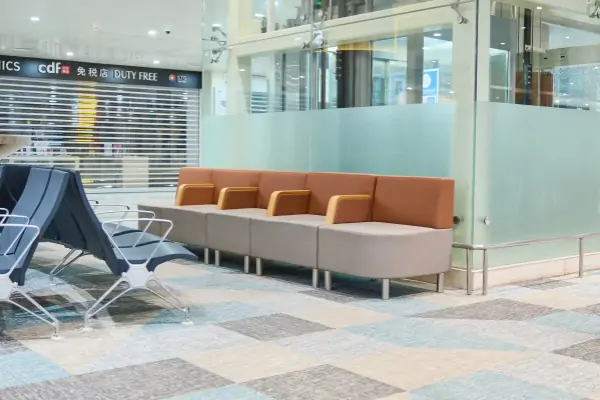
In high-traffic, high-usage environments like airports, an improper choice of Airport Leisure Chairs can easily lead to issues such as unauthorized relocation, rapid surface wear, and structural loosening.
The core conclusion is simple: to minimize maintenance costs, one must simultaneously address three key issues during the design phase: anti-theft measures, damage prevention, and durability.
I. Anti-Theft: From "Easily Removed" to "Difficult to Move"
The primary reason many airport leisure chairs go missing or are displaced is fundamentally due to their overly "independent" structural design.
A more sensible approach involves:
Adopting a multi-seat connecting design (modular Airport Leisure Chairs)
Implementing floor-mounting or semi-permanent anchoring in critical areas
Utilizing concealed, tamper-resistant structural components
The focus here is not on complete immobility, but rather on "controlled mobility."
II. Damage Prevention: Materials Determine 80% of Durability
In an airport environment, factors such as dragging luggage and frequent usage can significantly accelerate wear and tear.
It is recommended to prioritize the selection of:
Highly abrasion-resistant surface materials (e.g., wear-resistant PU or stain-resistant fabrics)
High-density foam cushioning (resisting compression even after prolonged sitting)
Reinforced metal frames (providing impact resistance and preventing deformation)
If the wrong materials are chosen, even the most brilliant design will fail to withstand the rigors of high-frequency usage.
III. Durability: Structures Must Be Engineered for "High-Frequency Environments"
Highly durable Airport Leisure Chairs typically possess three key characteristics:
Simplified structure (minimizing potential points of structural loosening)
Reinforced stress points (ensuring greater stability at seat surfaces and connection joints)
Suitability for luggage environments (featuring scratch-resistant and impact-resistant properties)
IV. Summary: Look Beyond Price; Consider the Product Lifecycle
Many projects initially opt for low-cost Airport Leisure Chairs, only to face the following consequences:
Frequent repairs required within 1–2 years
Higher replacement costs incurred in the long run
The truly rational approach is to make a single, well-considered selection that ensures over five years of stable, trouble-free operation.
Leave a message
Welcome you to leave your contact information and message, we will contact you by a personal person