admin01@oshujian.com
How to improve the overall management efficiency of airport waiting areas by planning the placement of trash cans?
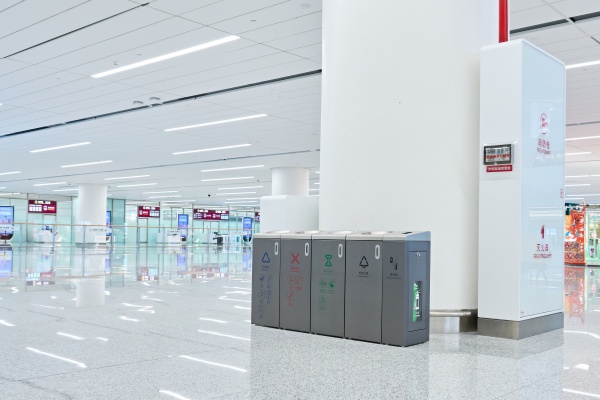
In large airport terminals, waiting areas generate a large amount of waste daily. The placement, number, and spacing of airport trash cans directly affect passenger disposal habits, the workload of cleaning staff, and the cleanliness of the area. So, how can the overall management efficiency of waiting areas be improved by planning the placement of airport trash cans? The core idea is to make the trash cans "follow the people," and for cleaning staff to "follow the paths."
I. Place trash cans along passenger movement routes to reduce littering.
Waste generation points in waiting areas follow a predictable pattern: boarding gate queuing areas, seating aisles, restaurant exits, outside restrooms, and near shops. When planning, trash cans should be placed along the natural walking direction of passengers at these points:
Boarding gate queuing route: Place a set of trash cans at both the entrance and exit of the queue for passengers to dispose of snack wrappers or empty bottles.
Seating Area: Place a small stainless steel trash can between every two rows of waiting chairs or at intervals of 15-20 meters, ensuring passengers can dispose of their trash within three steps of getting up.
Around the Dining Area and Retail Stores: Place larger trash cans 3-5 meters from the exit of the dining area to guide customers to dispose of their trash immediately after consumption.
Outside Restrooms: Covered trash cans must be provided, along with ground signage.
Placing trash cans according to passenger movement can reduce litter volume by over 40%, eliminating the need for passengers to actively search for trash and naturally fostering a habit of convenient disposal.
II. Coordinate with Cleaning Routes to Shorten Collection Paths.
Cleaning staff need to inspect and empty trash cans multiple times daily. If trash cans are scattered and irregular, it will result in numerous backtracking trips. The cleaning operation route should be considered during planning:
Circular or One-Way Layout: Trash cans should be arranged along the same side of the main cleaning route, forming a one-way loop to avoid backtracking.
Zoned Management: Each zone should consist of 4-6 trash cans, no more than 50 meters from the tool shed, facilitating quick replacement of trash bags. Centralized Transfer Points: Temporary trash cart parking areas should be set up near areas with high concentrations of trash cans (such as food service areas). Cleaning staff can place full bags into the carts and transport them to the garbage room in one go.
A scientific workflow allows cleaning staff to cover more bins per patrol, reducing collection time by more than 30% without increasing staff, thus improving efficiency.
III. Differentiated Classification and Capacity to Reduce Overflow and Odors
Different areas generate different types of waste, and trash can configurations should be differentiated accordingly:
Recyclables and Other Waste Should Be Placed Side-by-Side: Each group of bins should have at least two compartments, clearly distinguished by graphic markings. Bottle and can recycling outlets can be added near food service areas.
Capacity Adjustment: Recyclable bins near food service areas should have a larger capacity than other trash bins; the opposite should be true near boarding gates to prevent premature overflow of any particular type.
Avoid Air Conditioning Return Air Vents: Trash cans should be placed as close to walls and pillars as possible, avoiding placement under main airflow channels to prevent odor spread. Activated carbon filter covers can be installed on trash cans in food service areas.
IV. Actual Benefits: The Data Speaks for Itself.
After a hub airport was renovated according to the above traffic flow principles, the number of trash cans decreased by 8%, while coverage increased by 25%; cleaning staff's daily patrol routes were shortened by 35%, saving 2 hours daily for deep cleaning; the rate of passengers littering decreased by 60%, and complaints about overflowing trash dropped from 15 per month to 3. The frequency of garbage trucks entering the waiting area decreased from 4 times per day to 3 times, significantly reducing passenger disruption.
In summary, trash cans should be "nodes on the traffic flow," not isolated facilities. By placing them along passenger movement paths, coordinating with unidirectional cleaning routes, and combining sorting capacity with air management, we can achieve greater convenience for passengers, less effort for cleaning, and a cleaner environment.
For customized airport trash can traffic flow solutions or to purchase durable, sorting trash cans, please contact us. OSJ Furniture, founded in 2000, has assisted over 100 airports worldwide in upgrading by 2026. OSJ provides one-stop airport furniture solutions to meet all your needs.
Leave a message
Welcome you to leave your contact information and message, we will contact you by a personal person