admin01@oshujian.com
How do airport charging bar-style seats meet travelers' charging needs?
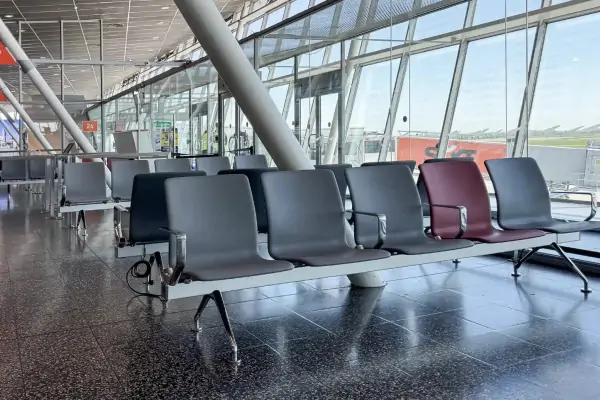
The key to meeting travelers' charging needs through airport bar-style seating lies not merely in "adding power outlets to chairs," but in utilizing a bar-height design to integrate three distinct actions—charging, device placement, and brief leaning—into a single, unified space. In contrast, when standard airport waiting chairs are retrofitted with charging ports, travelers are often forced to bend down to locate the outlets or balance their devices on their laps; bar-style seating effectively bridges this gap.
The bar-height design addresses the "posture maintained while charging."
Design guidelines from the Port of Seattle define airport charging stations as "counter-height ledges" where travelers can lean while charging their devices—a definition that underscores the necessity for a structure capable of supporting such weight. With a surface height typically exceeding 1,000 mm, these units allow travelers to view screens and operate devices while standing or leaning, eliminating the need to squat or spread luggage across the floor. Furthermore, by fixing the seat to a central column—ensuring it does not rotate—the design reduces the risk of components loosening over time due to frequent use.
Charging ports should be distributed according to the principle of "shared accessibility for adjacent users."
Civil aviation authority guidelines specify that when charging ports are integrated into seating, they should be positioned to serve travelers in neighboring seats. Priority should be given to USB ports or low-voltage (SELV) power systems. In practice, one can look to the configuration at Hefei Airport: each bar unit integrates 12 charging modules (each containing a standard multi-pin outlet, a USB-A port, and a USB-C port) along with 4 wireless charging pads—accommodating laptops, mobile phones, and a variety of cable types. Concentrating outlets in one spot often leads to queues; distributing them across the sides and center of the bar is far more practical.
Electrical safety is a non-negotiable requirement—not merely an optional "bonus"—in an airport environment.
Each USB port should feature independent overcurrent protection, and outlet panels must be tamper-resistant. The entire unit should ideally meet electrical safety standards for furniture, such as UL 962A. Cable management must be fully enclosed; exposed power strips or loose, trailing wires pose significant safety hazards in high-traffic terminal areas and also hinder cleaning efforts. Prioritize a low-voltage, USB-powered solution to eliminate the risk of electric shock at the source.
Durability and ease of maintenance determine the lifespan of these bar-style seating units.
In the airport seating industry, the baseline requirement is the ability to withstand constant use, impacts from luggage, and frequent cleaning with chemical agents. For upholstery, opt for PU or similar easy-to-clean materials, with high-density foam padding to ensure long-lasting resilience. Structural components should be standardized and interchangeable, allowing for the on-site replacement of individual chairs or charging modules without needing to remove the entire unit.
During the procurement acceptance phase, verify three key points: ensure the seating unit remains stable and wobble-free when fully occupied; test every port on each charging module (including verifying that overcurrent protection functions correctly); and confirm that all bolts securing the seats to the base structure are tightened on every unit. Only when these three criteria are included in the acceptance checklist can the "airport charging bar-seating" be considered properly delivered.
Leave a message
Welcome you to leave your contact information and message, we will contact you by a personal person