admin01@oshujian.com
Is It Necessary for Airports to Customize Retractable Belts in Different Colors to Enhance Passenger Flow Guidance?
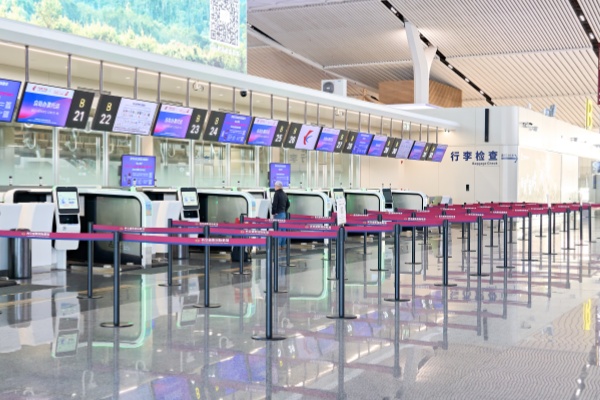
For airport managers, terminal operations heads, or public space designers—who face a daily passenger flow numbering in the tens of thousands—a seemingly minor detail warrants deep reflection: Are those ubiquitous retractable barriers merely simple physical dividers? Can customizing them in different colors truly enhance the effectiveness of passenger flow guidance?
The answer is: Not only can it do so, but—amidst the prevailing trends of building "Smart Airports" and "Human-Centric Airports" in 2026—customized retractable barriers have emerged as "invisible tools" for elevating the passenger experience and optimizing operational efficiency.
Retractable belts (also known as airport queuing belts or stanchion guide belts) are no longer merely a simple combination of "ropes and posts." When a color strategy is scientifically integrated into passenger flow design, it can—subconsciously to the traveler—fulfill multiple functions: guidance, zone demarcation, warning, and even mood regulation. Below, drawing from real-world scenarios, we deconstruct the inherent value behind color customization.
I. Color Acts as a "Silent Guide"
In the noisy and bustling environment of an airport terminal, text requires reading, and announcements require listening; however, color is the very first element perceived by the visual system. By strategically utilizing the colors of retractable belts, airports can effectively guide passenger flow even before travelers have fully deciphered the signage.
Rapidly Distinguishing Service Areas
International airports typically manage multiple concurrent processes: check-in, security screening, boarding, transit connections, and VIP services. If every area employs retractable belts of the exact same color, passengers can easily become disoriented. By customizing colors, airports can achieve the following:
Red retractable belts are used for warning zones (such as closed lanes, construction sites, or restricted boundaries).
Blue or green retractable belts are used for standard passenger queuing lanes, fostering a visual atmosphere of calm and order.
Gold or champagne-colored retractable belts are reserved for VIP check-in and First Class lanes, conveying a sense of exclusivity and prestige.
Yellow retractable belts are utilized for temporary traffic control or special directional guidance.
Passengers need only cast a quick glance at the color to roughly determine their intended path, thereby reducing hesitation and minimizing the need to ask for directions.
Optimizing Crowd Management Efficiency During Peak Hours
During morning rush hours or periods of heavy passenger volume—such as holidays—airports frequently need to make temporary adjustments to queuing paths. In such scenarios, portable retractable belt barriers offer greater flexibility than fixed fencing. By utilizing retractable belts in various colors, staff can quickly set up "temporary green lanes" or "priority lanes," using color as a visual cue to distinguish priority levels and prevent passengers from inadvertently entering the wrong queue.
II. Color Psychology: Making the Passenger Experience "Feel" Smoother
Airports are inherently high-stress environments—between rushing to catch flights, searching for boarding gates, and worrying about delays, passengers are already under significant psychological pressure. Studies in color psychology demonstrate that different colors can trigger distinct emotional responses.
Cool Tones (Blue, Green): These colors possess a calming and soothing effect. Deploying blue retractable belts in security screening queues can help alleviate passenger anxiety to some extent, making the often-tedious waiting process "feel" more manageable.
Warm Tones (Orange, Red): These colors serve as visual alerts and stimulants. They are ideal for priority lanes or areas requiring rapid transit, subconsciously encouraging passengers to quicken their pace.
Neutral Tones (Gray, Beige): Subtle and unobtrusive, these colors are suitable for general crowd control or boundary demarcation, ensuring they do not distract passengers from focusing on primary signage.
By customizing the colors of retractable belt barriers, airports can exercise "soft regulation" over passenger emotions without increasing staffing requirements.
III. Brand Image and the Nuances of a "Human-Centric" Airport
In 2026, airport competition has evolved beyond mere "passenger throughput" to encompass "passenger experience" and "brand recognition." Customized retractable belt barriers constitute an integral component of a terminal's visual identity system.
Consistent Branding: Many international airports possess a distinct brand color palette (e.g., the purple of Incheon Airport or the red of the Heathrow Express). Integrating these brand colors into retractable barriers ensures that passengers are immersed in a cohesive brand atmosphere from the very moment they step into the terminal.
Cultural Expression: Some airports customize color schemes based on the specific themes of different terminals or the cultural identity of the host city. For instance, the international zone might utilize blue—symbolizing the global sphere—while the domestic zone employs a warm orange, thereby infusing directional guidance with both functional efficiency and human warmth.
Holidays and Events: Customized retractable barriers can also be deployed for temporary events—such as red barriers during the Lunar New Year, a red-and-green combination during the Christmas season, or color schemes aligned with specific commercial promotions—adding vibrancy and dynamism to the airport space. IV. Balancing Durability and Visibility: Color Selection Goes Beyond Aesthetics
Customizing colors involves not only meeting visual requirements but also addressing practical considerations regarding durability and functionality during actual use.
Stain Resistance and Ease of Cleaning
Airport retractable belts experience extremely high usage frequency and come into frequent contact with passengers' hands and clothing. Light-colored webbing (such as pure white or light beige) tends to show dirt easily, thereby increasing cleaning costs. When customizing, priority should be given to darker color palettes (such as navy blue, burgundy, or forest green) or stain-resistant blended materials, striking a balance between aesthetic appeal and practical utility.
Reflectivity and Nighttime Visibility
Certain areas within an airport (such as arrival halls or underground passageways) may have dim lighting conditions. When customizing retractable belts, reflective threads or high-visibility woven fibers can be incorporated to ensure the belts remain clearly visible even in low-light environments, thereby enhancing safety for passenger guidance during nighttime hours.
Colorfastness and Aging Resistance
Airports often feature floor-to-ceiling windows and areas exposed to direct sunlight, where standard dyed webbing is prone to fading. Professional customization services should utilize polyester webbing with a UV-resistance colorfastness rating of Level 4 or higher, ensuring that the colors remain vibrant and vivid even after a full year of use.
Leave a message
Welcome you to leave your contact information and message, we will contact you by a personal person