admin01@oshujian.com
With continuously increasing airport passenger traffic, how to choose safer and more reliable retractable barriers?
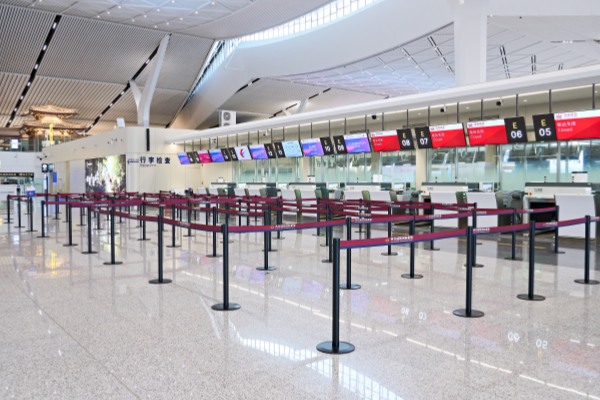
As the global aviation industry recovers, airport daily passenger traffic is repeatedly breaking records. In such high-pressure hubs, order management is no longer just a matter of efficiency, but also a matter of safety. As the "silent commander" guiding passenger flow, the value of airport retractable barriers is being redefined—it is not only a physical barrier, but also a smart node for risk management.
I. Four Major Safety Challenges Under Surge in Passenger Traffic
**Peak Congestion and Stampede Risk**
➤ Check-in areas and security checkpoints are prone to instantaneous crowd vortexes during peak hours, requiring barriers to have impact resistance.
**Life-or-Death Race in Emergency Lanes**
➤ In emergencies, barriers should be able to be quickly opened or disassembled to create a life-saving passage for rescue.
**Durability Crisis with Long-Term Use**
➤ With 24-hour continuous operation, ordinary barriers are prone to deformation, jamming, and even breakage.
**Adapting to Complex Scenarios in International Hubs**
➤ From duty-free shop queues to boarding gate crowd control, different areas require different isolation solutions.
II. Four-Dimensional Procurement Standards for Safety Barriers.
➤ Dimension 1: Structural Reliability – Visible "Steel Bones"
Material Selection: Aerospace-grade aluminum alloy strip pillars + polymer woven belt body, tensile strength ≥ 800kg
Core Components:
→ Self-lubricating bearing system (reduces jamming rate by 85%)
→ Anti-rebound locking device (prevents sudden contraction and injury)
➤ Dimension 2: Dynamic Adaptability – "Intelligent Elasticity" to Handle Flow Waveforms
Modular Design: Supports quick combination of U-shaped/L-shaped/serpentine patterns, adaptable to temporary traffic flow adjustments
Optimized Extension Ratio: Recommended 1:3 extension ratio (1 meter can be extended to 3 meters), saving 80% of storage space
➤ Dimension 3: Enhanced Safety Protection – "Guardian Heart" Hidden in the Details
Edge Treatment: UV coating on the belt body to prevent cuts, column head radius R≥ 10mm
Warning System: Embedded LED warning strip (automatically illuminates in low-light environments)
Fire Protection Standard: Passes ICAO fire protection test (burning drips ≤ 1 second self-extinguishing)
➤ Dimension Four: Sustainable Operation and Maintenance – Full Lifecycle Cost Control
Maintenance Indicators:
→ Tool-free disassembly and assembly design, component replacement ≤ 3 minutes
→ Belt life ≥ 500,000 expansion and contraction cycles
→ Supports partial replacement (no need for complete scrapping)
Conclusion: Safety is the silent promise that airports make to passengers.
When millions of passengers drag their suitcases through those winding, restricted passageways, they don't notice the self-lubricating bearings operating silently within the pillars, nor do they know that the Kevlar fiber layer in the belt is strong enough to withstand the impact of a trolley—but it is precisely these unseen details that form the safety foundation of modern aviation hubs.
Leave a message
Welcome you to leave your contact information and message, we will contact you by a personal person